
AI Talent Evaluation Platform for Healthcare Teams
Transforming how hospitals evaluate, compare, and grow clinical staff
Context
Wakura AI is a product incubated by Preux to solve inefficiencies in healthcare recruiting. Staffing teams spend excessive time on repetitive admin such as sourcing, scheduling, and ATS data entry, leaving less time for candidate engagement. In a $28B sector with chronic shortages, Preux saw an opportunity for an AI assistant built specifically for healthcare recruiters. Wakura integrates with recruiter workflows, automates routine tasks, handles candidate communication, and ensures data security. Preux led its development with input from industry experts to embed real recruiting logic into the AI.
Problem
-
Recruiters were overwhelmed with daily grunt work – e.g., sending follow-up emails, pre-screening applicants with the same questions, updating candidate records – leading to burnout and slower hiring processes.
-
Candidates often felt disengaged due to delayed responses or lack of personalized communication, as human recruiters could only handle so much at once. This was especially true in healthcare, where qualified nurses or technicians might move on if not engaged promptly.
-
Healthcare staffing involves complex scheduling and credential checks. Coordinating interviews or shifts across different time zones and ensuring candidates have required licenses was prone to error when managed manually.
-
Data was siloed in ATS, calendars, email, etc., without a unified view. Recruiters had to constantly switch between systems to track progress, leading to inefficiency and missed details.
-
Management lacked real-time insight into recruiter productivity and pipeline health. Generating metrics (like time-to-hire, drop-off reasons) required manual logging and was often inconsistent.
Solution
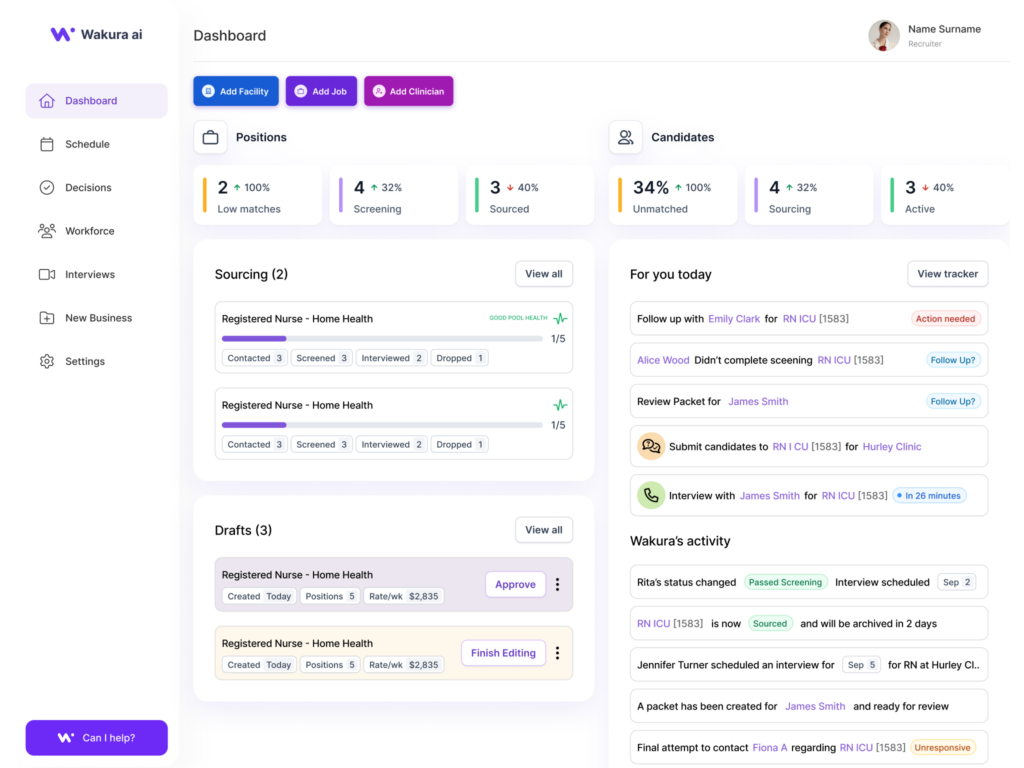
Wakura AI is a virtual recruiting assistant designed by Preux to automate repetitive tasks while working alongside human recruiters. It integrates with existing ATS and calendar systems to streamline outreach, scheduling, screening, and data entry.
Wakura handles candidate communication via chat or email, using natural language processing to respond to FAQs and collect key information. Recruiters are looped in only when human input is needed.
It schedules interviews by syncing with recruiters’ calendars, offering candidates available times, sending invites, and handling follow-ups.
The AI screens resumes for each role, ranking candidates by qualifications like certifications or specialty areas, and provides rationale for each suggestion.
Wakura updates the ATS automatically, logging interactions and moving candidates through stages without manual input.
It also generates analytics dashboards showing time-to-hire, drop-off points, and workflow delays, helping teams prioritize action.
All data is securely handled, with compliance and bias mitigation built in by design.
Outcome
Early implementations of Wakura AI with pilot users have demonstrated substantial productivity gains. Staffing agencies reported that their recruiters’ time spent on administrative tasks dropped by about 40%, freeing them to spend more time on candidate relationships and strategic outreach. In concrete terms, tasks like scheduling an interview – which might take several email exchanges over a day – are now handled in minutes by the AI. This contributed to a faster time-to-hire (often 20–30% quicker) for urgently needed roles, an invaluable improvement especially in high-turnover positions like nursing. Recruiters also experienced less burnout; anecdotal feedback highlighted that having routine work handled by Wakura made their jobs more satisfying, as they could focus on the human side of recruiting.
Candidates benefited through quicker responses and a smoother process. Even outside of business hours, candidates could get answers about a job or updates on their application status from the AI assistant, leading to increased engagement. No-show rates for interviews have begun to decline because Wakura sends polite reminders and makes rescheduling simple, ensuring candidates don’t slip through the cracks. In one trial, a mid-sized healthcare staffing firm saw fill rates improve because qualified candidates were pipelined faster – their recruiters were able to handle a 50% larger candidate pool with the same team size, thanks to Wakura’s assistance in multitasking.
Wakura AI is still in the growth phase, but its early success with key clients and positive ROI metrics (productivity up, hires faster, and administrative errors down to near zero) indicate a strong product-market fit. The platform’s introduction has also become a selling point for agencies using it – they can differentiate themselves to hospitals by saying they leverage AI to fill roles faster and more reliably. Internally, Preux regards Wakura as a strategic offering in its portfolio, underlining the company’s commitment to innovative, high-impact solutions. With continuous improvements and scaling, Wakura AI is poised to become an indispensable co-worker for recruiters, not just in healthcare staffing but potentially in other sectors where similar inefficiencies prevail.
Technology




-
1
CXO
-
2
UX/UI
-
1
Engineer
About Preux Software
Preux is a high-trust software development partner, known for embedding dependable, well-structured teams into ambitious organisations.
We specialise in delivering web platforms, SaaS products, and compliance-driven systems with particular strength in regulated sectors like healthcare and finance.
Our distributed teams — drawn from top-tier European talent — include developers, QA engineers, project managers, and UX designers. We work across modern stacks including Node.js, React, .NET, and Laravel, integrating AI and ML where it adds real, strategic value — not for show, but to solve meaningful problems.
Clients choose us not just for technical execution, but for the clarity, composure, and strategic insight we bring to complex builds. With a track record that includes Rolls-Royce, IBM, CryoFuture and Axxelist, Preux is trusted by companies who value quality over haste, and precision over hype.
Looking for a tech partner to help you scale your startup or grow your team?
Let’s arrange a brief call to understand your goals and explore how Preux might support them.